

Does anyone know where the love of God goes
When the waves turn the minutes to hours?
Today marks the fiftieth anniversary of the wreck of the Edmund Fitzgerald. Twenty-nine men lost their lives in that horrific tragedy. In commemorating their loss, singer-songwriter Gordon Lightfoot wrote one of the most beautifully penned tributes ever set to music—a haunting ballad that has outlived even the ship itself.
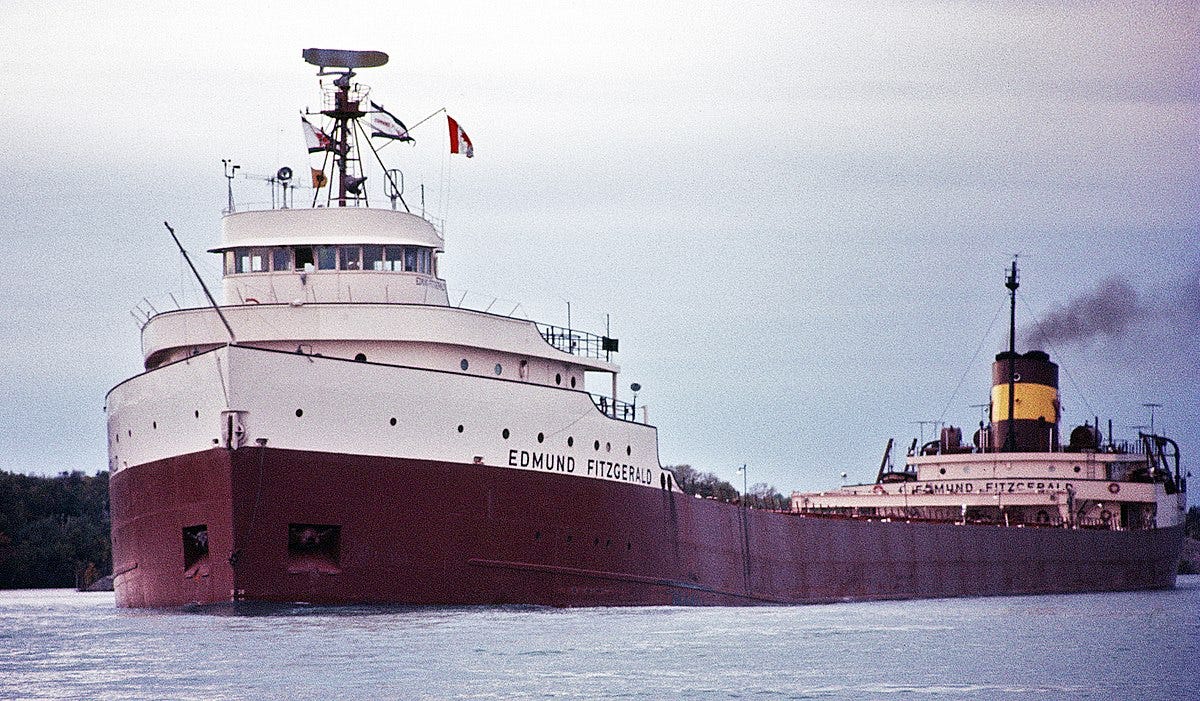
The SS Edmund Fitzgerald was an American freighter that sank in Lake Superior on November 10, 1975, during a fierce storm, claiming the lives of all 29 crew members. When launched in 1958, she was the largest ship ever to sail the Great Lakes and remains the largest to have sunk there. For 17 years, she hauled taconite ore from the Minnesota Iron Range to ports in Detroit, Toledo, and beyond, often setting records for seasonal hauls. Known affectionately as “The Pride of the American Side,” the Fitzgerald became a familiar sight to Great Lakes watchers—especially under Captain Peter Pulcer, who was known for playing music and narrating the ship’s passage over the intercom as it traveled the waterways between the lakes.
While the cause of the ship’s sinking would not be fully understood for years, Lightfoot’s song captured the mystery and sorrow of that night. He took a few creative liberties in his lyrics, later revising them during live performances as new information came to light. One of my favorite anecdotes involves a simple edit: in his original version, Lightfoot described church bells ringing “in the musty old halls.” The congregation in question politely objected to the word musty, so he changed it to rustic old halls. It’s a small but charming reminder that even in mourning, a touch of humanity remains.
The Fear of the Sea
Throughout history, the sea has been a symbol of chaos and danger. Ancient cultures understood its power and unpredictability—its vast, uncontrollable depths represented mystery, terror, and divine judgment. In Scripture, the sea often stands for the forces of disorder that only God can tame. The psalmist writes, “You rule the raging of the sea; when its waves rise, you still them” (Psalm 89:9).
It’s no surprise then that when the disciples found themselves caught in a violent storm on the Sea of Galilee, they were terrified. Their small boat was being tossed by the waves, and they cried out to Jesus, convinced they were going to die. But with a word, He stilled the storm. “Peace! Be still!” (Mark 4:39). And the wind and waves obeyed Him.
That moment revealed a profound truth: Jesus is Lord over the chaos. The same God who spoke creation into order commands the winds and the sea. The same voice that silenced the storm in Galilee still speaks today.
Yet it’s important to remember—He does not always calm the storm. The Fitzgerald still went down. There are times when the waves keep rising and the minutes stretch into hours of fear and loss. But even then, Christ remains sovereign. He is still the Lord of the wind and the waves. His plan may not be to stop the storm, but to redeem what lies beyond it.
Where the Love of God Goes
But it’s that central question—the line I quoted above—that has stayed with me:
“Where does the love of God go when the waves turn the minutes to hours?”
There are moments in life when time seems to stretch and ache under the weight of grief. When tragedy strikes, when the world feels like it’s falling apart, when all we can do is wait and endure—we find ourselves asking where God’s love has gone.
Lightfoot doesn’t give an answer. I don’t fault him for that. In many ways, that silence is the right response of a heart in lament. The truth is, in those moments, we rarely see the love of God. But by faith, we know it is there.
The storm is not the time for answers. The night of loss is not when explanations bring comfort. There will be a day when all will be made clear—when every sorrow will be accounted for, every loss redeemed, every question answered. Until then, we cling to the promise that God has planned all things for good, even when the waves rage and the minutes turn to hours.