

We live in a strange cultural moment—one where people laugh at meaning while desperately searching for it. Scroll long enough, and you’ll find humor that mocks sincerity even as it reaches for it. For years, Christians have critiqued postmodernism, but culture has not stood still. Many now believe we’ve moved beyond it into something new.
Metamodernism names this cultural moment. It represents an evolution from the predominant cultural viewpoint of the last half-century. Postmodernism emphasized deconstruction across media, language, art, and literature—questioning grand narratives and destabilizing traditional frameworks.
Metamodernism, as described by cultural theorists, reflects an oscillation between two poles: meaning and sincerity on one hand, and meaninglessness and absurdity on the other. It emerges as a reaction to the postmodern world we have inhabited for more than fifty years. The deconstructive efforts of postmodernism left culture without a stable narrative by which to interpret reality, and this instability is reflected in the art of the period.
Postmodernism, with its radical deconstruction, was, in many ways, shaped by a broader scientific and materialistic worldview. Within that framework, morality, beauty, truth, and logic are reduced to products of evolution and chance—stripped of inherent meaning. Those who embrace such a worldview are often left with two options: existentialism or nihilism. Either meaning does not exist at all, or it does not exist inherently and must be constructed.
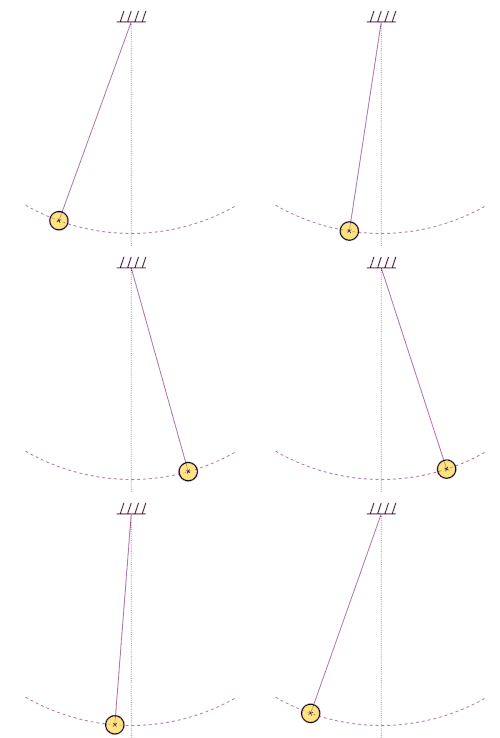
The metamodern turn is often described as a pendulum swinging between these extremes. It reflects the inescapable human longing for truth, beauty, and morality—a longing we cannot silence. Yet the image of a pendulum, while helpful, is incomplete.
The Apostle Paul describes this kind of instability in Ephesians:
“So that we may no longer be children, tossed to and fro by the waves and carried about by every wind of doctrine, by human cunning, by craftiness in deceitful schemes.” — Ephesians 4:14 (ESV)
Whereas scholars describe metamodernism as a pendulum, it may be better understood as a bungee cord. Because we are made in the image of God, we possess an inescapable awareness that truth, beauty, and morality are real—and we live as though they are. Yet, under the weight of modern assumptions, humanity is driven to leap into a lower story stripped of meaning. What follows is a free fall into emptiness and despair
.
But this position cannot be sustained. The absurdity of a meaningless world presses in, and man is violently pulled back upward—reaching again for meaning, purpose, and beauty. Yet this return lands him only in a fragile upper story, one that cannot bear the weight of the longings it tries to support.
This dynamic is increasingly evident in contemporary media and in the style of humor embraced by the current generation. The humor is often self-aware, ironic, and deeply sincere all at once—laughing at meaning while simultaneously longing for it.
In Bo Burnham: Inside, Bo Burnham embodies this tension. Throughout the special, he oscillates between satire and confession, irony and vulnerability. Songs like “That Funny Feeling” capture a quiet despair at the state of the world, while still reaching for something real beneath the absurdity. The performance itself becomes a kind of bungee cord—falling into meaninglessness while straining toward meaning.
Similarly, the music of Taylor Swift—particularly in Folklore and Evermore—reflects a renewed sincerity layered with self-awareness. There is a return to storytelling, emotion, and beauty, yet always with an awareness of fragility and loss. These songs long for meaning without confidently grounding it.
In Barbie, directed by Greta Gerwig, this same tension is explored through satire and sincerity. The film begins with a playful, ironic critique of identity and cultural expectations, yet gradually shifts into an earnest exploration of purpose, identity, and what it means to be human. It laughs at meaning even as it searches for it, ultimately landing in a space that longs for truth but cannot fully ground it.
Films such as Everything Everywhere All at Once put this tension on full display as well. The film presents an existential vision of absurdist hope, acknowledging that within a purely secular framework there is no ultimate foundation for meaning or sincerity, yet still urging the viewer to choose hope in the face of absurdity.
The Bible, however, offers a fundamentally different vision of reality—one that provides a true grounding for truth, beauty, morality, and logic.
These realities exist because there is an eternal, triune God who has revealed Himself in both His Word and His world. As Francis Schaeffer wrote, “He is there, and He is not silent.”
In his trilogy—The God Who Is There, Escape from Reason, and He Is There and He Is Not Silent—Schaeffer describes reality using the analogy of a two-story house.
The upper story is the realm of meaning, values, purpose, morality, beauty, and ultimate truth.
The lower story is the realm of facts, nature, science, and empirical observation—what can be measured and tested.
Schaeffer traces the development of this divide back to Thomas Aquinas, who distinguished between nature and grace. While not intending to divide truth, this distinction was later expanded through rationalism into a separation between nature and freedom.
The problem with this division is that, over time, the lower story begins to consume the upper story. When meaning is detached from truth, it cannot sustain itself. As history progresses, the divide becomes one between rationality and faith. Rationality, confined to the lower story, leads to pessimism, while optimism is pushed into the upper story as something non-rational—a leap without grounding.
As the lower story continues to erode every foundation for meaning, various substitutes emerge. Existentialism attempts to create meaning. Later, forms of mysticism—including drug-induced experiences—seek to recover a sense of transcendence. Yet each of these proves insufficient, unable to provide a stable grounding for truth, beauty, or morality.
Now, in the wake of postmodernism, we can better understand our cultural moment. We are not merely swinging between extremes—we are falling and recoiling. We leap into meaninglessness, only to be pulled back by a longing we cannot escape. We reach for meaning, only to find that what we grasp cannot hold us. Metamodernism is more akin to bungee jumping. Free fall then recoil.

Sharing the gospel in this context requires clarity that cuts through both the fall and the recoil. The answer for this cultural moment is not something new, but a solid ground for those who have been tossed to and fro by the waves of an indecisive age.
At the lowest point of the fall lies nihilism—the recognition that a worldview separated from God ultimately collapses into meaninglessness, truthlessness, and the loss of beauty. Yet even here, people cannot live consistently with that conclusion. They continue to long for meaning, revealing that they were not made for such a world.
In the recoil, we see the rise of existentialism—the attempt to construct meaning, assert value, and recover purpose. Yet this effort cannot hold, because it lacks the grounding of objective truth.
This creates a powerful point of connection. Even in their fall and recoil, people reveal that they know something is real. They are reaching for a truth they cannot escape and cannot construct.
This gives us a clear opportunity. When people laugh at meaning, they are not rejecting it—they are revealing how deeply they long for it. When they reach for purpose, they are reaching for something real. The task of the church is not to invent meaning, but to point to the One who grounds it.
The gospel provides what neither the fall nor the recoil can offer: a true and lasting union between truth and meaning. In the biblical worldview, truth is meaningful, and meaning is true—because both are grounded in the character of God and revealed supremely in His Word.
a call toward deeper instincts for truth, beauty, and morality