

My wife and I have three boys, and with each pregnancy, we had the same conversation that many couples have: “What are we going to name this little one?” We have always believed that names carry significance. We decided that each of our children would have a family name connecting them to us and a name connecting them to our faith: Judah Grant, Jonathan Knox, and Ransom James.
The Bible provides ample example of this in Isaiah 8. In the middle of his prophetic message to King Ahaz of Judah, Isaiah conveys a divine message through the name of his son.
Isaiah 7 and Isaiah 9 are often quoted during this time of year. Isaiah 7 declares:
“Therefore the Lord himself will give you a sign. Behold, the virgin shall conceive and bear a son, and shall call his name Immanuel” (Isaiah 7:14, ESV).
Isaiah 9 continues:
“For to us a child is born, to us a son is given; and the government shall be upon his shoulder, and his name shall be called Wonderful Counselor, Mighty God, Everlasting Father, Prince of Peace” (Isaiah 9:6, ESV).
Yet Isaiah 8 and its surrounding context are often overlooked because they are difficult to interpret outside their historical and literary setting.
Full Context
Isaiah wrote during the Syro-Ephraimite War, when Syria and Israel conspired to attack Judah and replace King Ahaz with a ruler sympathetic to their agenda (Isaiah 7:1–2). During this section of Scripture, two of Isaiah’s children are mentioned. The child at the center of Isaiah 8 is Maher-Shalal-Hash-Baz, a name meaning “speed the spoil, hasten the prey” (Isaiah 8:1, ESV). The Lord instructs Isaiah:
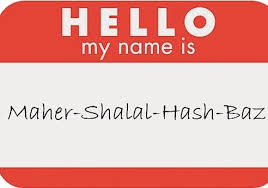
“Then the LORD said to me, ‘Take a large tablet and write on it in common characters, “Belonging to Maher-shalal-hash-baz.” And I will get reliable witnesses, Uriah the priest and Zechariah the son of Jeberechiah, to attest for me’” (Isaiah 8:1–2, ESV).
And again:
“Call his name Maher-shalal-hash-baz; for before the boy knows how to cry ‘My father’ or ‘My mother,’ the wealth of Damascus and the spoil of Samaria will be carried away before the king of Assyria” (Isaiah 8:4, ESV).
This practice is not uncommon in Scripture. Time and again, God instructs parents to give their children names with prophetic significance. These names serve as living messages—words made flesh—communicating God’s truth, judgment, and hope to all who witness them.
In this way, the names of Isaiah’s children, the words of the prophet, and ultimately the coming Messiah form a continuous thread: God’s Word is not static. It is alive, active, and present among His people. This is a form of Immanuel—God with us.
This is the word made flesh and a prelude to the ultimate Word made flesh in Jesus Christ (John 1:14).
Maher-Shalal-Hash-Baz was fully human. He nursed from his mother, learned to walk, and cried as babies do. His parents cared for him—cleaned and changed him, taught him to speak. Yet even in these ordinary rhythms of life, he was a message from God. He was a living, breathing reminder that God speaks to His people. I honestly hope he had a nickname—can you imagine Isaiah’s wife calling Maher-Shalal-Hash-Baz inside for dinner? Each time that name was spoken, it was a reminder of God’s message of judgment and, ultimately, of salvation. Sin would bring judgment, but God would bring salvation.
The prophesied names of the promised Messiah painted a picture of who He would be. He would be Immanuel, God with us, Wonderful Counselor, Everlasting Father, and Prince of Peace. Yet we call Him Jesus, as the angel instructed Joseph:
“She will bear a son, and you shall call his name Jesus, for he will save his people from their sins” (Matthew 1:21, ESV).
Every child named by God in the Bible carries a message of hope and points forward to the ultimate child—the Messiah—whose coming was foretold long before He entered the world.