

I was out at the playground just after sunrise because my boys had been up since around 4 AM. We were laughing and running around. It was the first time I had been to this playground in our town in a while, and I noticed that they had torn down the accessible playground and replaced it with a Noah’s Ark playground. I can only assume this was because it was cheaper to replace the accessible playground with a smaller, inaccessible one. All that is left is a ramp that leads to nothing. But as a Christian whose life has been deeply impacted by disability, I couldn’t miss the irony of exchanging accessibility for a cheaper option with a biblical flavor.
I had to take a picture. There was something striking about seeing it in a public park, with a cross in the background and the beautiful sun peeking through the trees.
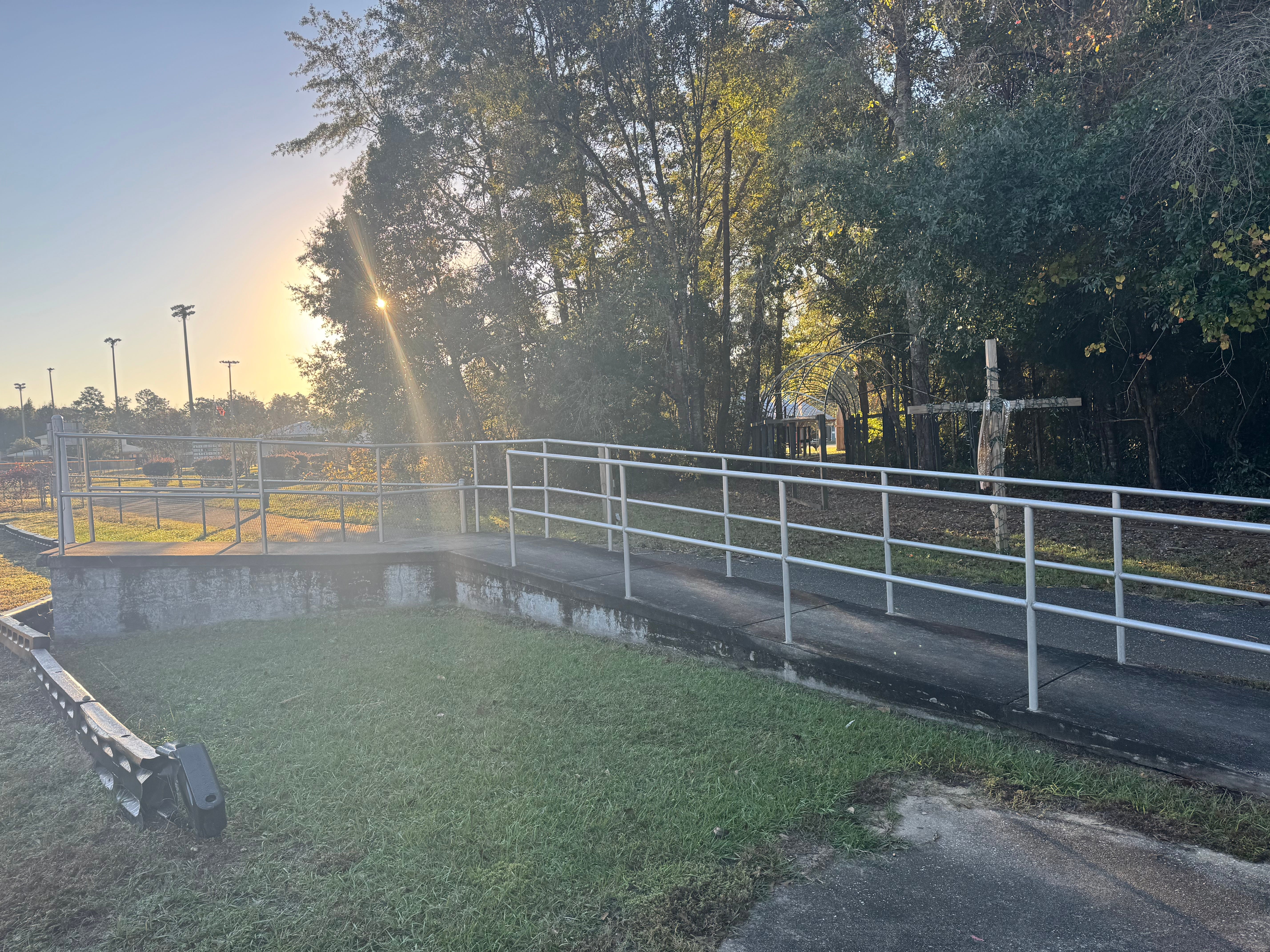
As a pastor with a heart for discipleship, disability ministry, and student ministry, I couldn’t help but see the heartbreaking parallel between this monument to inaccessibility and so much of our modern ministry. We have a way in for people, but not a place for them to belong and thrive.
The Church
In the church, when someone new comes, they can join, get baptized, and give. But in many churches, there is no process for integrating these new folks into the life of the church. Many slowly begin to fade until one day you look up and they are gone, and no one has stopped to ask why. They got to the top of the ramp and found no place for them.
Student Ministry
So many of the children and students who come through our ministries find community and love from their student ministry leaders and peers. Yet they eventually reach the end of their time in student ministry and fall right off. They have had opportunities and fellowship, but the isolation of children and youth from the broader church, coupled with a lack of intergenerational discipleship, leaves them without a clear path forward. They had a great place to get on, but they weren’t really heading anywhere.
Disability Ministry
Some of our churches are doing more than most to serve people with disabilities. They have separate classes, trained volunteers, budgets, and rooms specifically designed for them.
They have the on-ramp. Praise God! But what is the goal?
What Is the Goal?
For each of these areas, what is our goal?
Colossians 1:28 tells us that we are called to present everyone mature in Christ. Pastors are called to equip the saints for the work of ministry. In our outreach ministries, student ministries, and disability ministries, our goal must be to integrate people meaningfully into the life and work of the church.
The goal is maturity on this side of heaven and glorification in the life to come.
We don’t just want a church where new people, students, and those with disabilities are welcome, but one where they are prepared for the work of ministry and transformed by the glory of God. They need to move from infancy in Christ toward full maturity. They need to move further up toward Christ and further into the body of Christ.
These two directions overlap. It is about going up the ramp, higher and higher toward Christ, and inward toward the destination of maturity and meaningful integration into the life and mission of the church.
Erik Carter of Baylor University created this graphic to illustrate different models of disability ministry. Granted, I think it applies far beyond disability ministry. It illustrates how we view those outside the church and how we bring them in.
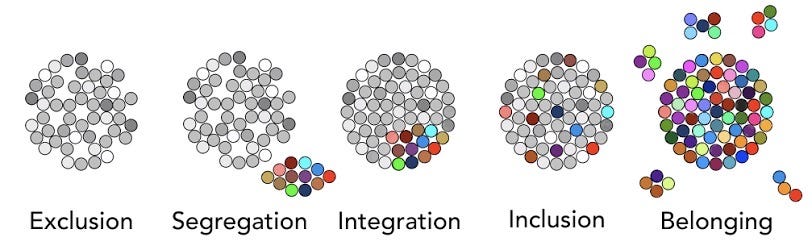
We can have no ramp at all and be completely shut off from those outside. Almost every Christian would acknowledge that this is wrong. We proclaim that grace is for everyone and that it doesn’t matter what one’s age, race, background, or level of ability may be. Yet many churches lack a ramp, both physically and socially. This is what Carter depicts as exclusion.
Then there is the ramp to nowhere. These ramps will vary in length and size, but no matter where they stop, the destination is the same. Churches can host a class or small group, build a room, put in ramps, or host an outreach. But until people are not only brought inside but also find unity within the body, and are then equipped to go back out, serve, and bring others with them, the ramp remains a ramp to nowhere. This is where Carter’s framework would place separation, integration, and even some forms of inclusion. Belonging is found when people are not merely attending and participating in activities but are also included in the mission and purpose of the church.
This applies to the church as a whole, and to disability and student ministries specifically.
How Do We Connect the Ramp?
Connecting the ramp is both structural and relational. What really connects anyone to the body of Christ is not simply faithful attendance, but rather the relationships that form the bonds of fellowship.
The command to make disciples of all nations does not exclude those outside the church, those under eighteen, or those with disabilities. Rather, it includes everyone. The command is not simply to make converts, attenders, givers, or recipients of pity or ministry, but disciples who follow Jesus. We make this commitment public through baptism and then teach them to obey everything Jesus has commanded. This means proclaiming the gospel, teaching all of Scripture, and, importantly, teaching this very command itself. The Great Commission is self-referential: we are to make disciples who make disciples.
If we are not pursuing this with people with disabilities, we are once again building an on-ramp to nowhere. If someone is present when we gather but is never meaningfully included in the life and mission of the church, we have not fulfilled our responsibility to disciple them. Our goal cannot simply be to have people in the room. We want them to know Christ, grow in Christ, belong to His body, and participate in His mission. This participation will look different from person to person, but every member of the body matters.
Not to mix metaphors, but this reminds me of the book The Trellis and the Vine. We can spend so much time building trellises that we forget the purpose of the vine. We build programs, classrooms, structures, and systems, but these things are only valuable insofar as they serve the growth of the people who make up the church. The structures are not the destination; they are meant to support the growth of the vine.
Our ramps, classrooms, student ministries, and outreach programs must serve the greater purpose of making disciples who grow in Christ and are meaningfully connected to His body. We don’t need more ramps that lead nowhere. We need pathways that lead people toward maturity in Christ and deeper fellowship with His people. We need structures that promote inclusion not just in the life of the church but also in its mission. We need structures that cross the worldly barriers that Christ has already torn down spiritually. We need structures that promote relationships between new and established members, between generations, and among people of different abilities and backgrounds.
But ultimately, the church is both organic and organizational. We cannot simply change systems and expect people to change. We must also disciple our people to break down these barriers relationally. We must do so in our sermons, small groups, and personal discipleship. When the structures and relationships are both in place, our churches can move from exclusion toward belonging. This will take us further up and further in, and eventually back down the ramp and out into the world.
Needed this today. Isaiah told the eunuchs that even though they had no children to carry on their name, God would give them a place and a name in his house better than sons and daughters (Isaiah 56:3-5). A ramp without that kind of belonging on the other end is still exclusion, just slower.