

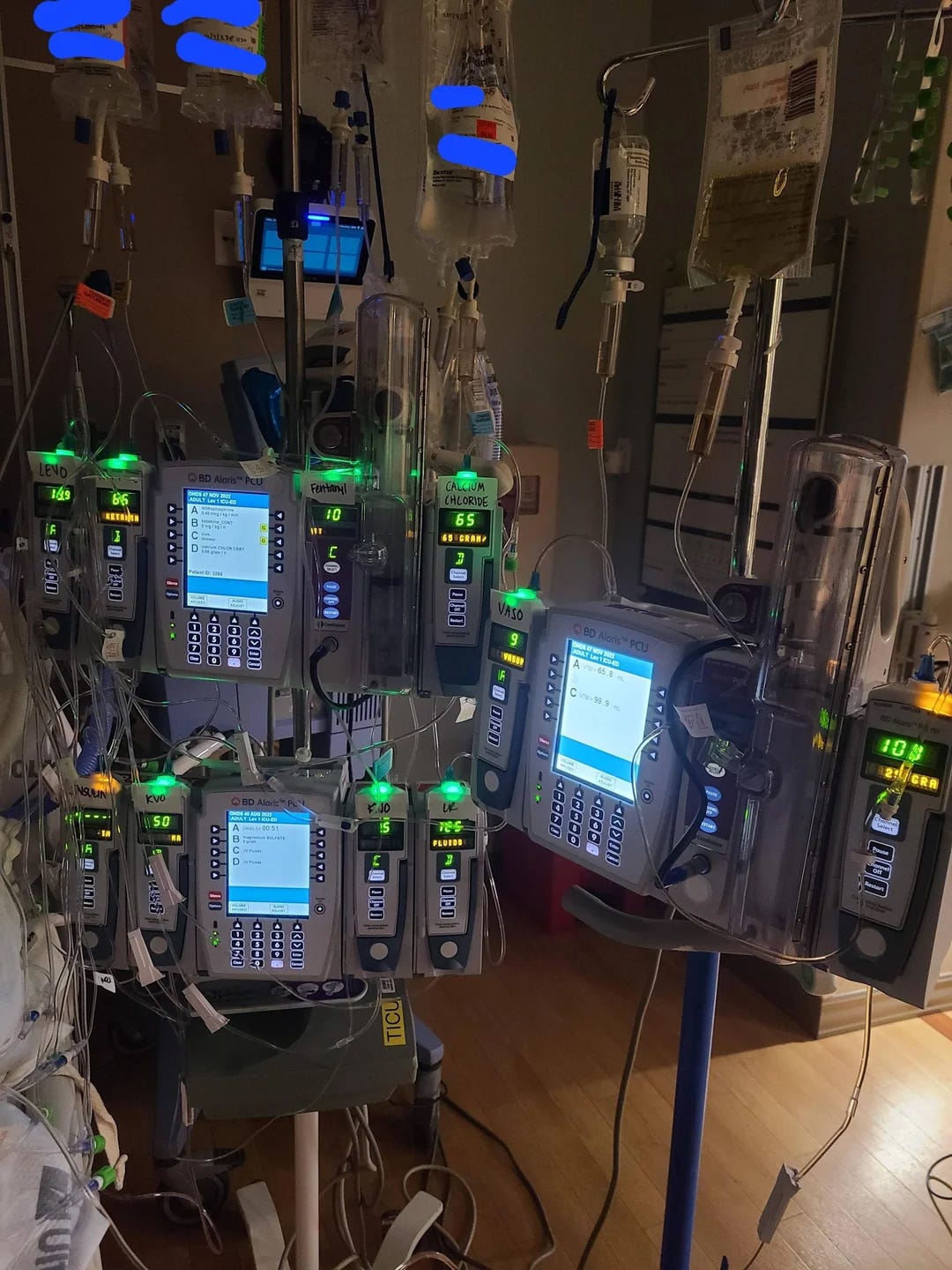
I am haunted by the season we spent in the hospital. If you have ever had a medically complex child or spent any amount of time in the ICU with a loved one, you know exactly what I mean.
I can still hear and identify each beep and warning bell that was hooked up to my infant son. From the subtle beep of the IV pump, signaling that an infusion was complete, to the blaring gongs of the respiratory machine, those sounds are burned into my memory.
Near the end of our hospital journey, Knox, our little warrior, had learned exactly which cords to pull to make the alarms go off and send the nurses running in. Even now, at home, we still have him hooked up to a heart rate and oxygen monitor. Sometimes, we will be driving down the road, and I swear I hear my son's feeding pump going off, even though I know it isn't even in the car. These phantom noises haunt me. I have woken up in the dead of night, convinced I hear the machines beeping, only to realize they aren't real.
Medical experts say these are symptoms of PTSD (Post-Traumatic Stress Disorder). In fact, studies show that parents of medically complex children or children with severe disabilities are significantly more likely to suffer from PTSD, anxiety, and depression than the general population.1
I see those symptoms reflected in Scripture in the raw, unfiltered pain of men like Job and David:
“The thing that I fear comes upon me, and what I dread befalls me.” (Job 3:25, ESV)
“My eye has grown dim from vexation, and all my members are like a shadow.” (Job 17:7, ESV)
“I am weary with my moaning. Every night I flood my bed with tears.” (Psalm 6:6, ESV)
“Fear and trembling come upon me, and horror overwhelms me.” (Psalm 55:5, ESV)
The Bible is honest about suffering, trauma, and the way fear can cling to us long after the danger has passed.
So, what do we do when we are haunted by the ghosts of past trauma?
What are Christians to do when the memories will not fade and the alarms still echo in our minds?
Here are some practical steps and pastoral counsel from someone who has walked this road:
1. Turn to the Lord
David, in response to overwhelming anxiety and the pressures of life, turned to the Lord with confidence:
“But I call to God, and the LORD will save me. Evening and morning and at noon I utter my complaint and moan, and he hears my voice. He redeems my soul in safety from the battle that I wage, for many are arrayed against me. God will give ear and humble them, he who is enthroned from of old.” (Psalm 55:16-19, ESV)
The Lord does not turn away the anxious, the weary, or the overwhelmed. He invites us to cry out, and He promises to hear.
2. Seek Safe and Godly Counsel
There are times when we simply cannot carry the weight alone. God has designed us for community. Sometimes all that is needed is a fellow believer to sit with you, listen to your struggles, and pray. Other times, you need a pastor or someone with spiritual wisdom to walk alongside you.
But be humble enough to recognize that some situations require more than just general Bible knowledge. If your trauma is bleeding into your marriage, your parenting, your sleep, or your daily functioning, do not hesitate to seek help. Ask your pastor or doctor for recommendations for a Christian counselor, preferably someone trained to understand medical trauma or grief.
A key part of this is finding someone safe. Look for the friend who listens, not just the fixer. Look for the person who will genuinely pray for you and guard your confidence.
“Therefore encourage one another and build one another up, just as you are doing.” (1 Thessalonians 5:11, ESV)
3. Follow Good Health Practices
When Elijah found himself in the depths of despair, overwhelmed by fear and exhaustion, the Lord sent an angel to minister to him. But notice what the angel did:
“And he lay down and slept under a broom tree. And behold, an angel touched him and said to him, ‘Arise and eat.’ And he looked, and behold, there was at his head a cake baked on hot stones and a jar of water. And he ate and drank and lay down again.” (1 Kings 19:5-6, ESV)
God did not immediately address Elijah’s spiritual condition. He first gave him rest, nourishment, and time.
Your body matters. Your sleep, nutrition, movement, and basic health rhythms matter. Trauma often leaves us physically depleted. Do not neglect the simple graces of caring for your body as part of your healing. See more here.
“Or do you not know that your body is a temple of the Holy Spirit within you, whom you have from God?” (1 Corinthians 6:19, ESV)
While this verse speaks directly to purity, the broader biblical principle reminds us that our bodies belong to God and should be cared for accordingly.
4. Look to Christ
Your struggle is deep and real, but we serve a Savior who suffered more than we can imagine. We serve a great High Priest who has walked the valleys of this broken world. We serve a God who has promised that all the suffering of this life is “light and momentary” compared to the eternal glory awaiting us.
“For we do not have a high priest who is unable to sympathize with our weaknesses, but one who in every respect has been tempted as we are, yet without sin.” (Hebrews 4:15, ESV)
“For this light momentary affliction is preparing for us an eternal weight of glory beyond all comparison.” (2 Corinthians 4:17, ESV)
Christ knows. Christ sees. Christ has not abandoned you in your trauma. He walks with you, even when the beeping still echoes and the fears still whisper.
If you are struggling, please know you are not weak. You are not faithless. You are human. And God is near to the brokenhearted.
“The LORD is near to the brokenhearted and saves the crushed in spirit.” (Psalm 34:18, ESV)
“He heals the brokenhearted and binds up their wounds.” (Psalm 147:3, ESV)
Look to Christ. Look and live.
https://pmc.ncbi.nlm.nih.gov/articles/PMC10087969/