

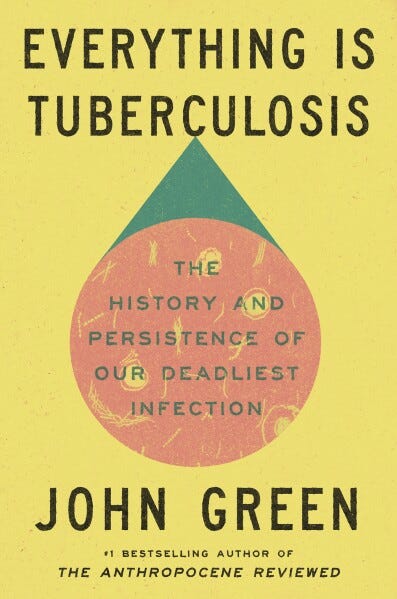
When I first heard the title of John Green's most recent book, Everything is Tuberculosis, I was intrigued but not immediately blown away. I discovered John Green on YouTube back in 2011. At the time, he was already well known as a young adult novelist but was rapidly expanding his platform through the Vlogbrothers channel with his brother, Hank. Over the years, I’ve appreciated his ability to blend deep thought with accessible storytelling, and this book is no exception.
While this book was a fantastic piece of writing on its own, what stood out to me most was how it wrestled with the ways we, as human beings, search for meaning and patterns in our world. Green explores our innate desire to make sense of suffering, randomness, and the chaos of life. This theme is summed up beautifully in a quote he includes from Kurt Vonnegut:
“Tiger got to hunt, bird got to fly;
Man got to sit and wonder 'why, why, why?'
Tiger got to sleep, bird got to land;
Man got to tell himself he understand.”
Romanticizing and Stigmatizing Suffering
One of the most compelling aspects of Everything is Tuberculosis is Green’s exploration of how people have both romanticized and stigmatized tuberculosis (TB) throughout history. For centuries, TB was associated with poets, artists, and great thinkers. Known as the “disease of genius,” it was sometimes seen as almost mystical—something that heightened one’s creativity even as it took one’s life. Writers like John Keats and Emily Brontë died from TB, and their suffering was woven into their legacies in a way that made the disease seem tragic yet poetic.
At the same time, TB carried a heavy stigma. Those diagnosed were often isolated, sent to sanatoriums, and treated as if they were a danger to society. The fear of contagion led to widespread mistreatment and societal rejection, particularly for the poor, immigrants, and marginalized communities.
The Parallels to Autism and Disability
As the parent of a child with autism, I couldn’t help but see the parallels to how society treats disability. Much like TB, autism has been both romanticized and stigmatized. Films like Rain Man have painted an unrealistic picture, elevating autistic individuals as savants while ignoring the daily struggles that many face. This kind of portrayal creates an expectation that every autistic person has some extraordinary gift, which in turn makes it harder for those who don’t fit that mold to be understood and supported.
At the same time, autism—like TB—has also led to stigma and isolation. Families dealing with severe autism often find themselves cut off from social circles, struggling against misconceptions that their child is “difficult” or “undisciplined.” The burden of caregiving is made heavier when society either misunderstands or outright excludes those who don’t fit neatly into its norms.
A Christian Response: Loving Without Illusion or Fear
As Christians, we are called to respond differently. Jesus neither romanticized nor shunned those who were sick or disabled—He simply loved them. When He healed lepers, He didn’t do so because they had some hidden beauty in their suffering, nor did He recoil from them as the rest of society did. Instead, He met them with both truth and compassion.
In the same way, we must acknowledge the real challenges faced by those who are sick, disabled, or marginalized, without turning their struggles into a spectacle or a symbol. True love doesn’t require suffering to be poetic, nor does it turn away from hardship out of discomfort. It simply meets people where they are, just as Christ meets us.
Final Thoughts
Everything is Tuberculosis is more than a book about disease—it’s a meditation on how we assign meaning to suffering, sometimes in ways that are helpful and sometimes in ways that are deeply harmful. Green’s reflections challenge us to look at the world more honestly, to acknowledge the pain of others without distorting or dismissing it.
For those of us who are caregivers, parents, or simply trying to love others well, the takeaway is clear: real love exists in the space between idealization and rejection. It’s in the willingness to walk with others in their suffering, not needing to explain it away, but simply choosing to be present.