

If you have your Bible, will you open with me to 1 Corinthians chapter 3, and we’re going to look at verses 18 through 23. If I am honest with you, this is one of those passages that I have been looking forward to since about six months ago when I started praying and reading through First Corinthians. First Corinthians 3:18–23 gives us some vital insight and a truth we often overlook about our inheritance in Christ.
Look with me, verse 18, and we’ll read to the end of the chapter. It says this:
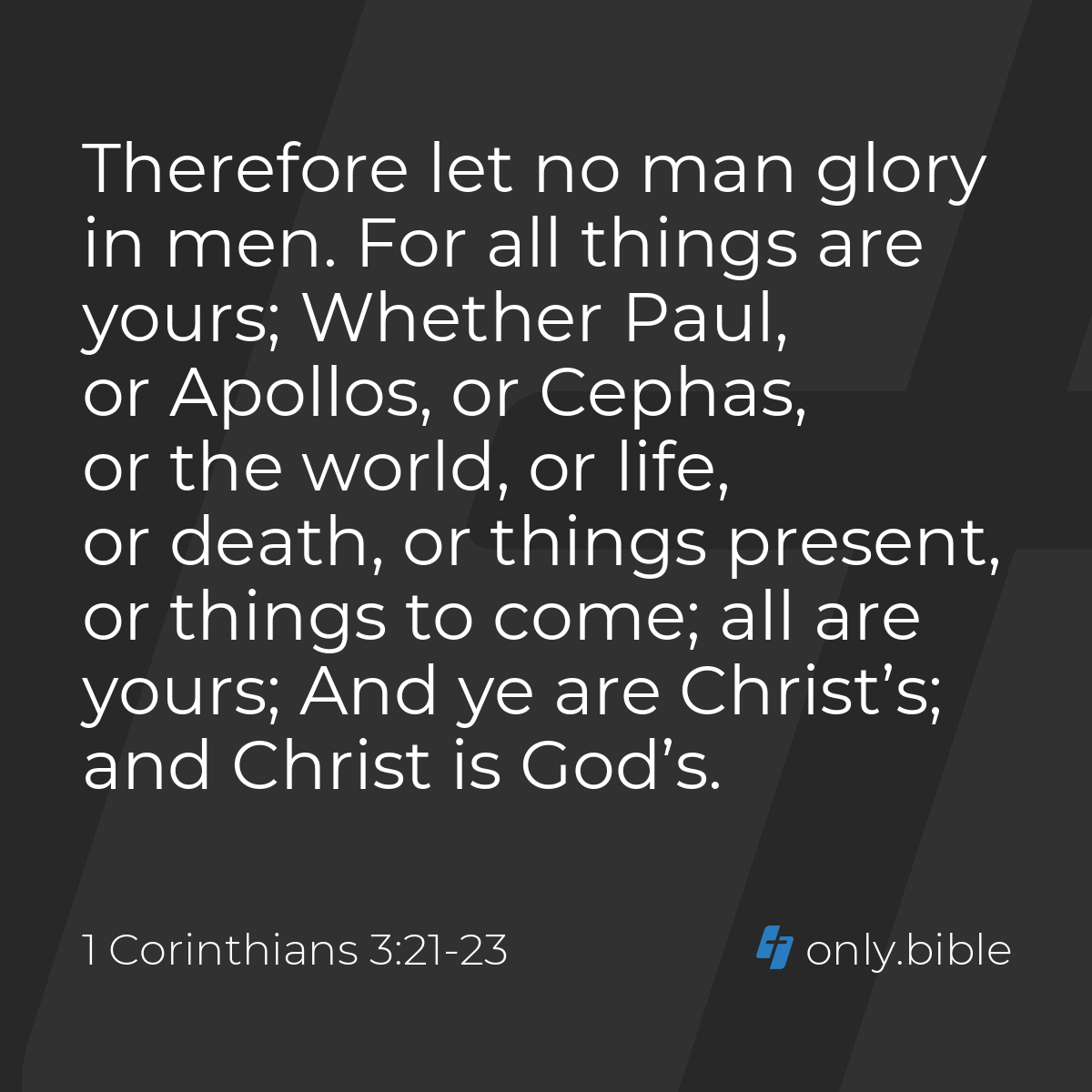
“Let no one deceive himself. If anyone among you thinks that he is wise in this age, let him become a fool that he may become wise. For the wisdom of this world is folly with God, for it is written, ‘He catches the wise in their craftiness,’ and again, ‘The Lord knows the thoughts of the wise, that they are futile.’ So let no one boast in men. For all things are yours, whether Paul or Apollos or Cephas or the world or life or death or the present or the future—all are yours, and you are Christ’s, and Christ is God’s.”
Paul has been dealing with an issue of pride within the church—an issue of division within the church. Pride and division and boasting all have a root cause. It is a cause both of thinking too much of yourself and of thinking too low of yourself. It is both thinking that you have this elevated status, but oftentimes it comes from a low view of self because you think yourself so low that you have to invent ways to lift yourself up and put yourself out where you are higher than you actually are.
Our boasting often comes from our insecurity because we believe that we have to say things about ourselves or align ourselves in certain ways to lift ourselves up. But in reality, we don’t need to lift ourselves up or cast ourselves down. We need to find what the Bible says about us and believe it. Amen.
We don’t need a lower view of self or a higher view of self—we need a biblical view of self. Amen. We need to view ourselves in light of what the Bible says.
I. The Root Problem: Self-Deception (v.18)
Verse 18 says this: “Let no one deceive himself. If anyone thinks he is wise in this age, let him become a fool, that he might become wise.”
That phrase, “Let no one deceive himself,” appears a couple of times in First Corinthians.
1 Corinthians 6:9 – “Do you not know that the unrighteous will not inherit the kingdom of God? Do not be deceived.”
1 Corinthians 15:33 – “Do not be deceived: Bad company ruins good morals.”
We can easily deceive ourselves in our own perspective, in our own worth, in our own value, in our own place, within the church, within society. But Paul repeatedly encourages the church and encourages us today not to deceive ourselves.
A lie is evil, but a lie to oneself can be even more dangerous because it is easier to believe a lie that you tell yourself than a lie that someone else tells you. We have to be on guard even against our own thoughts and minds because we can lie to ourselves so easily.
Paul says, “Do not deceive yourself. If anyone thinks he is wise in this age, let him become a fool.” Funny enough, the word fool is moros in the Greek. It’s where we get our word moron. Literally, Paul is saying, If anyone thinks he is wise in this age, let him become a moron so that he might actually be wise.
If anyone thinks he has all the wisdom and knowledge and understanding of this world and is relying on the wisdom of the age rather than the wisdom of the Scriptures, let him actually get a true biblical view of himself, a true biblical view of Jesus Christ and Him crucified, and believe the truth that the world despises. By becoming a fool, you actually become wise. By turning away from the wisdom of this world—from the pride of this world, from the seeking of being in the inner circles of this world—you now become truly, biblically wise.
II. Becoming a Fool to Become Wise (vv.18–19)
Verse 19 says, “For the wisdom of this world is folly with God, for it is written, ‘He catches the wise in their craftiness.’ And again, ‘The Lord knows the thoughts of the wise, and they are futile.’”
That phrase “He catches the wise in their craftiness” is interesting because Paul is quoting Job 5. If you read the book of Job, you know that Job’s friends often spoke wrongly, and God rebuked them for speaking wrongly. But even in their wrong statements, sometimes they spoke truth, and Paul quotes one of those truths: He catches the wise in their craftiness.
The wisdom of this age is a trap that Satan uses to lie, manipulate, and cause us to deceive ourselves. And Paul is saying that God catches the wise in their craftiness. The Lord knows the thoughts of the wise—that they are futile, that they are empty, that they amount to nothing in the end. The so-called “wise” of this world, the ones who think they have it all figured out, are ultimately outsmarted by God Himself. All of their plotting, all of their schemes, all of their philosophies and arguments that set themselves up against the knowledge of God—He sees through every one of them. He exposes their emptiness. He turns their own cleverness back on their heads.
This is why Paul is warning us not to get swept up in the wisdom of the age. What the world calls brilliance, God calls foolishness. What the world prizes as insight, God exposes as vanity. And if we are not careful, we will be tempted to measure our lives, our ministries, and even our faith by standards that God Himself has already declared futile.
III. Gifts and Inheritance (Expanded Treatment)
Paul then shifts from warning us against worldly wisdom to reminding us of our inheritance. He says, “Let no one boast in men. For all things are yours…”
All things. Everything. This includes teachers: Paul, Apollos, Cephas. The wisdom of these men, their writings, their sermons, their lives—all of it belongs to you to study, enjoy, and learn from. Every good biblical teacher throughout history belongs to you: Augustine, Calvin, the Puritans, Edwards, Spurgeon, modern teachers—if their teaching aligns with Scripture, it is yours to benefit from.
It also includes Scripture itself—the Law, the Prophets, the Gospels, the Epistles. Old and New Testament, every translation, every passage—yours to read, meditate on, and let God speak through. And it goes further: the world itself belongs to you. Every river, mountain, ocean, galaxy, star, and logical truth. Nature, math, science, music, art—God has gifted these for your enjoyment and growth in wisdom.
I think of my son Knox? Something as simple as watching him laugh, seeing how he notices small wonders in the world, reminded me that the simplest gifts—the sunshine, the birdsong, a splash of water—belong to us in Christ. Even the mundane is sacred, a taste of God’s generosity.
IV. Life, Death, Present, and Future (Expanded Treatment)
Paul expands the inventory: “life or death…present or future.”
Life: Every heartbeat, every joy, every friendship, every challenge, every ordinary moment is a gift. Life is a divine gift, sacred and precious.
Death: Though painful and feared, death is a passage to eternity. For believers, it is not the end, but a doorway to joy and completeness with Christ. Like the seed that dies to grow, death ushers us into everlasting life.
Present: C.S. Lewis writes that the present is the point at which time touches eternity. God is here, now, in the moment, even in mundane routines. Satan would distract us with guilt over the past or fear of the future, but the present is a gift from God to be enjoyed, stewarded, and lived in worship.
Future: Every detail, trial, blessing, and joy is already under God’s sovereign control. The future is secure because we belong to Christ. Nothing is outside His plan, nothing escapes His hand.
All these gifts—teachers, Scripture, creation, life, death, the present, and the future—are yours because of Christ. “You are Christ’s, and Christ is God’s.” Without Him, the gifts are meaningless. With Him, they are yours to steward, enjoy, and let draw you closer to the Giver.
V. Application and Invitation: Living as Children of the King
All things are yours because you belong to Christ, and Christ belongs to God. This is not just a theological concept—it is a daily reality. It should shape the way we live, worship, relate to others, and see ourselves.
Boasting in men, wealth, or connections is unnecessary. All things already belong to you. You don’t need to lift yourself up. You don’t need to compare yourself. You are secure. You are loved. You are a child of the King.
Let these gifts draw you closer to God. Let the teachers, Scriptures, creation, life, death, present, and future point you to the Giver. Let them humble you, teach you, and glorify God in your heart. Do not allow division, pride, or envy to rob you of your inheritance.
For those who may not yet know Christ personally, the only way to truly access these gifts is through a living relationship with Jesus. Without Him, the gifts are meaningless. But when you belong to Him, all things become yours—and most importantly, the Giver Himself becomes yours.
The altar is open this morning. If you have never committed your life to Jesus, or if you need to renew your trust in Him, come forward. Pray, talk with someone, and take hold of the greatest inheritance: the love of God, the salvation of your soul, and the promise of eternal life.
If you are already a believer, let these truths humble you and fill you with gratitude. Let the divine inventory—the gifts of God—draw you closer to the King of Kings. Live as a child who knows the Father owns all things, and let that assurance shape your life, your decisions, and your worship.
Amen.


